“Africa finally spoke in one voice. This is history.”
VIEWER POST · ACCRASTATE OF FLAME · LIVE ARCHIVE
The Lagos Address
WORLD DESK LIVE · LAGOSSPECIAL REPORT
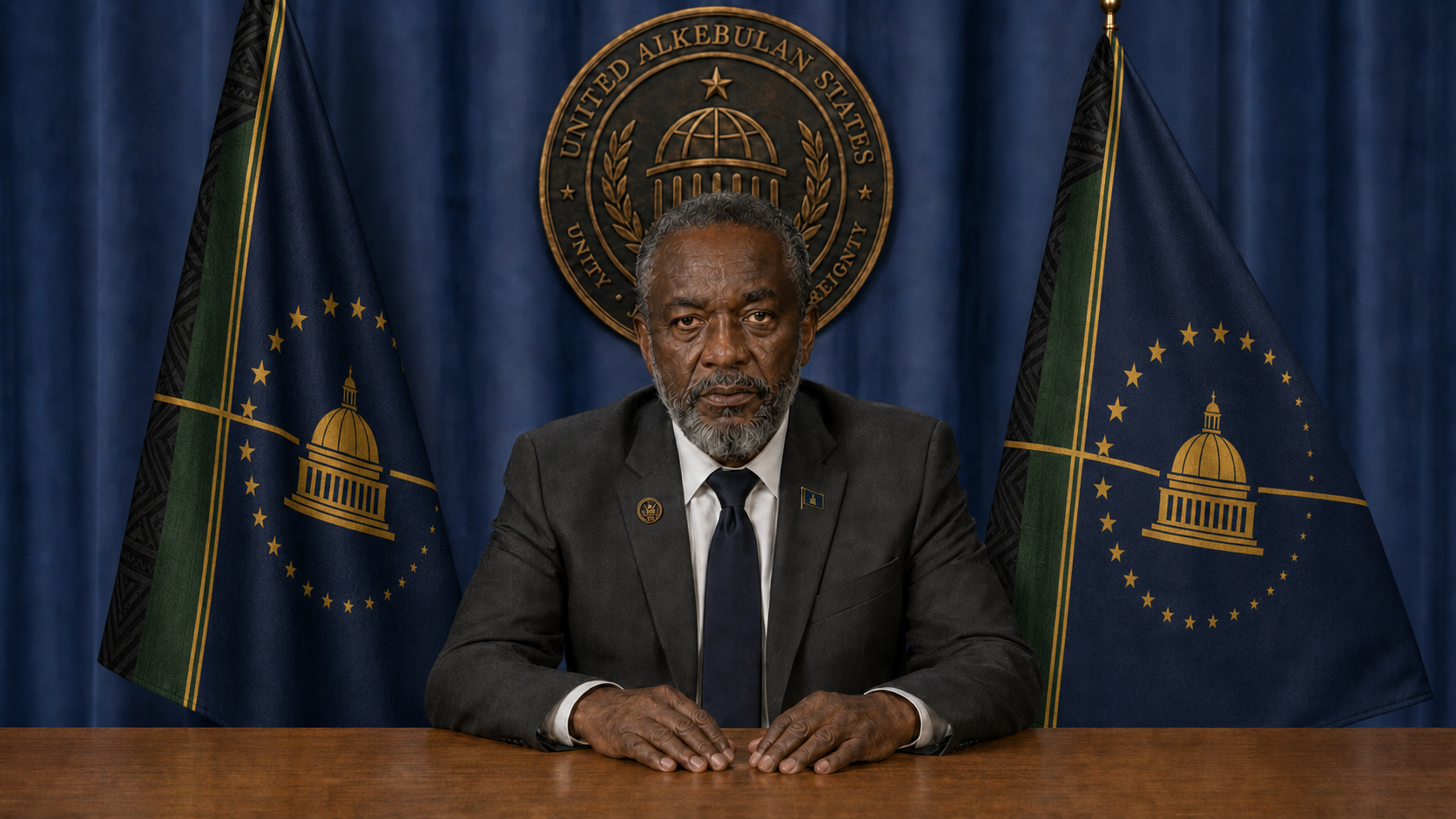
United Alkebulan StatesDay 1 · 12:00 GMTLagos
WORLD REACTIONLIVE FEED
“The balance of power changed at noon.”
DIPLOMATIC CORRESPONDENT · PARIS“They did not unite. They are terrorists taking the banking system hostage.”
CABLE NEWS GUEST · WASHINGTON“Forty-one African states under one Black government? The civilized world should be terrified.”
CALL-IN RADIO · LONDON“No shots. No tanks. Just signatures—and the world still panicked.”
VIEWER POST · JOHANNESBURG“If Europe did this, they would call it visionary.”
UNIVERSITY STUDENT · SÃO PAULO“Markets do not know whether to celebrate or run.”
FINANCIAL CORRESPONDENT · SINGAPORE“One Africa. One future.”
CROWD CHANT · LAGOSKAELO MWANGI · THE LAGOS ADDRESS
Complete broadcast · 5 minutes 27 secondsRead the broadcast transcript
KAELO MWANGI · LAGOS
Good afternoon. My name is Kaelo Mwangi. As of twelve hundred hours Greenwich Mean Time, today, I have the honour of serving as interim chair of the executive council of the United Alkebulan States. I am speaking to you from Lagos.
I would like to begin by describing what has happened, what is happening, and what will happen, in plain language and in the order in which it occurred.
At six o’clock this morning, instruments of accession were deposited with a secretariat in Lagos by representatives of forty-one sovereign African states. Each instrument of accession was signed by a head of government empowered to do so under his or her own constitutional authority. Each instrument was filed in compliance with the domestic ratification procedures of the signing state. Each instrument is now public, and may be reviewed at any time by any interested party at the URL displayed on the lower portion of your screen.
The forty-one acceding states are listed alphabetically beneath the URL. They include all of the major economies of sub-Saharan Africa and a majority of the economies of North Africa. Together they represent approximately eighty-three percent of the population of the African continent and approximately ninety-one percent of its measurable economic output.
The instruments of accession do three things. They dissolve the African Union, by the same operation of law that, in 2002, dissolved the Organisation of African Unity. They transfer the treaty obligations of the dissolved entity to a successor entity, which is the United Alkebulan States. And they authorise the executive council of the new entity to assume custody, with effect from twelve hundred hours today, of the foreign reserves and sovereign assets of the acceding states.
The transfer of foreign reserves was completed earlier this morning. It was conducted in compliance with the existing custody agreements between the acceding states and their foreign correspondent banks. No bank’s instructions were countermanded. No vault was breached. No asset was moved without the explicit written authorisation of its lawful owner. The new central bank of the United Alkebulan States, whose charter was published in fourteen national gazettes on Friday, is now the lawful custodian of these assets.
I anticipate questions. I will not be taking questions today. I will, however, address three of them now.
The first question is whether the United Alkebulan States is a sovereign country in international law. It is. The instruments of accession satisfy the requirements of the Vienna Convention on Succession of States in Respect of Treaties, to which all forty-one acceding states are signatories, and the Montevideo Convention on the Rights and Duties of States, to which thirty-eight are. The new country has a defined territory, a permanent population, an effective government, and the capacity to enter into relations with other countries. It will be applying for membership in the United Nations General Assembly later this week.
The second question is what happens to the existing diplomatic, commercial, and treaty relationships of the acceding states. They are inherited, in their entirety, by the new country. No existing treaty is abrogated. No existing trade agreement is invalidated. No existing diplomatic mission is closed. The new country assumes the rights and the obligations of its predecessor states in the proportions set out in the schedules attached to the instruments of accession.
The third question is what this means for the rest of the world. It means, in the short term, very little. Trade will continue. Aircraft will fly. Cargo will move. Contracts will be honoured. Loans will be serviced. Embassies will operate. The United Alkebulan States is not, today, asking the rest of the world to do anything. It is informing the rest of the world that, as of twelve hundred hours today, certain conversations that were previously held with forty-one capitals must henceforth be held with one.
In the longer term, it will mean more. We will have things to say. We will have positions to take. We will have proposals to make. Those conversations will begin in due course, through the appropriate channels, in the appropriate forums. They will be conducted with the seriousness they deserve.
For now, I would like to thank the citizens of the forty-one acceding states for the patience and the trust they have shown in the months and years leading to this morning. I would like to thank the citizens of the thirteen non-acceding countries for the consideration they have given to the question and to assure them that the door of the United Alkebulan States remains, and will remain, open. And I would like to say, to the rest of the world: we have not done anything today that any other country, in any other century, has not done before us. We have only done it, perhaps, more carefully.
Thank you. Good afternoon.
ENTER THE STORY
The declaration was the beginning.
In State of Flame, the world confronts the arrival of a unified African country—and the pressure placed on the people responsible for keeping it alive.